

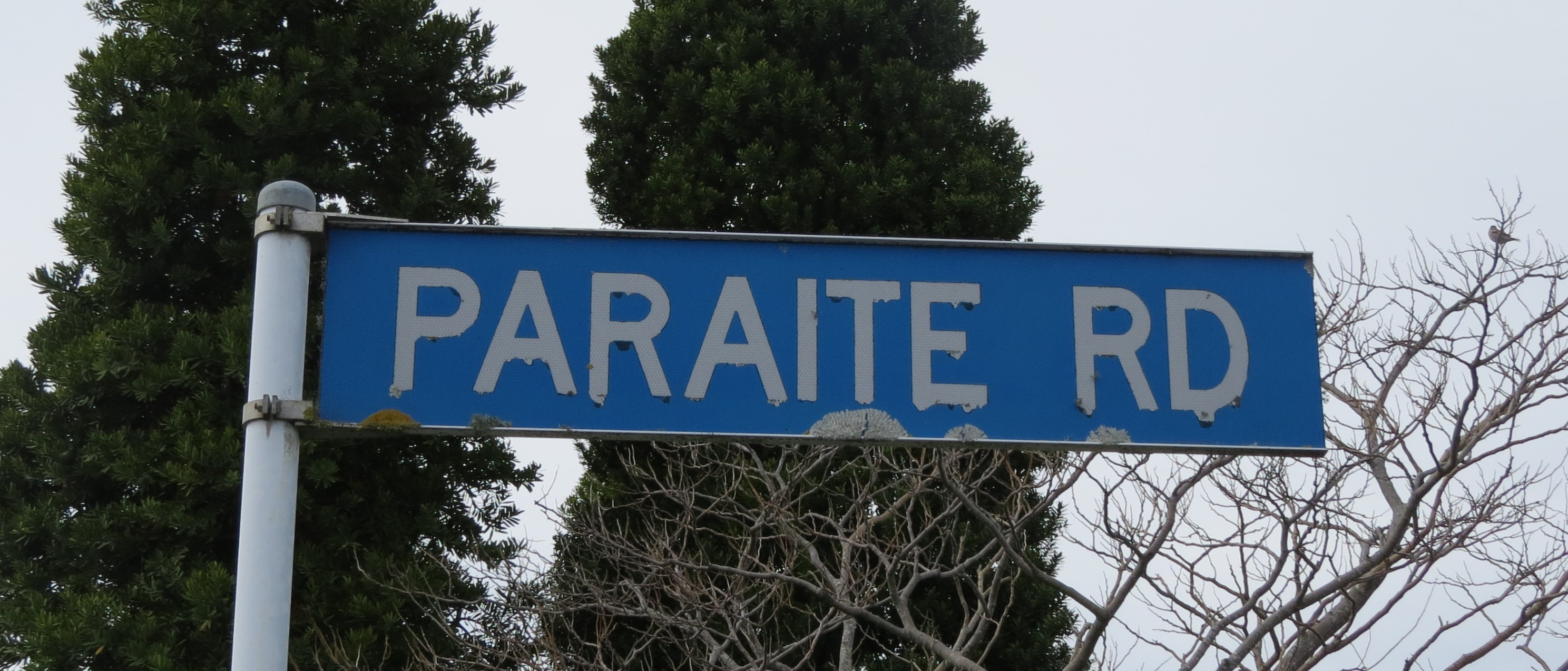
Paraite Road in Bell Block was named after a nearby pā constructed on top of an ancient lahar.
The small pā, located just west of the intersection of Paraite, Belmont and Townsend Roads, was known as Paraiti but the spelling of the road seems to have been fairly fluid – Paraiti or Paraite – until the 1960s.
In the 18th century Potaka Taniwha, an elderly chief of the Puketapu hapū from Paraiti Pā, fell in love with Urukinaki, the beautiful daughter of Kahu Taiaroa, a rangatira from nearby Parihamore Pā. He led a war party to take her by force and Parihamore Pā ran out of provisions during the resulting siege so Urukinaki was eventually married to Potaka to restore the peace.
During the Taranaki Wars, the people of Paraiti Pā sought refuge at Mataitawa Pā near Lepperton. In May 1860, a company of Imperial troops from the 40th Regiment put up a stockade for signal communication with Waitara on Paraite Road. It was named the Northcroft Stockade in honour of the landowner but was destroyed just a few days after the troops left.
The earliest mention of Paraite Road appears in the Taranaki Herald in September 1858 and it was later crossed by the old Marton to New Plymouth railway line, constructed in the 1870s. Metalling of the road began in 1936, after which it was used for weekly runs by the New Plymouth Harrier Club.
The April 1963 issue of the popular New Plymouth Photo News magazine featured a chicken factory on Paraite Road that was said to be one of the largest table poultry producers in the country. The article pointed out that chicken was fast becoming “a real competitor to the meat trade” – little knowing that by the 21st century the average Kiwi would be eating twice as much chicken as pork and four times as much chicken as beef every year. That company is now Tegel Foods, still located on Paraite Road. McKechnie Brothers opened a metal extrusion factory on Paraite Road in 1966, confirming Bell Block as the region’s most important industrial centre.
Interestingly, the word ‘paraiti’ now means ‘blight’ in te reo and usually refers to potato blight. An epidemic of this disease, caused by the fungus Phytophthora infestans, infected crops throughout New Zealand between 1904 and 1906 and had a significant effect on local Māori, for whom potatoes were a staple food source during winter. The Taranaki Daily News reported in February 1906 that the blight “has been so severe throughout the province this season that the Maoris will have a particularly hungry time of it during next winter.” The same blight had caused over a million people to die of starvation in Ireland in the 1840s so the government was rightly concerned. The Native Department provided Māori growers with equipment to spray their crops with fungicide, supplied more modern blight-resistant potato cultivars and distributed seeds to encourage them to grow a wider range of vegetables. These tactics were successful and the blight had subsided by 1907.
This story was originally published in the Taranaki Daily News.
Related Documents
McKechnies of Bell Block (Taranaki Herald 2 March 1966)
Please do not reproduce these images without permission from Puke Ariki.
Contact us for more information or you can order images online here.
The information on this website is provided for general research and reference only. While we try to keep content accurate and current, we make no guarantees about its completeness or correctness. It should not be considered a replacement for a LIM or a Property Report. Some content is supplied by third parties. Puke Ariki has not verified this content and users should check its accuracy before relying on it.The inclusion of a building on the website does not imply heritage status. See SCHED1 in the NPDC District Plan for a list of buildings that have rules about what can happen to or around them (administered by NPDC). See the New Zealand Heritage List for a list of buildings that are celebrated for their heritage significance but are not subject to rules (administered by Heritage New Zealand Pouhere Taonga). Should any corrections need to be made to the records or for more information please contact us.


