

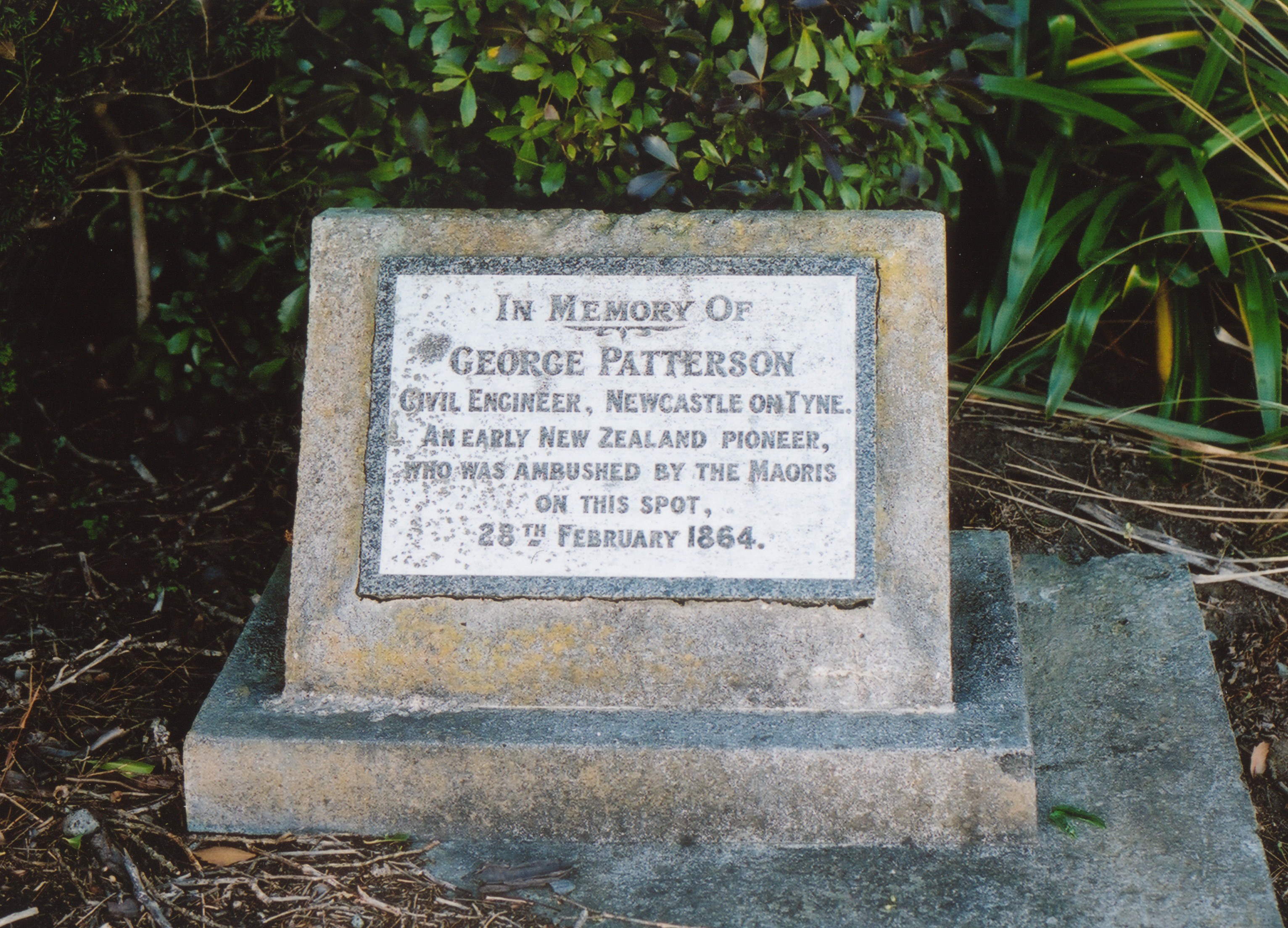
George Patterson made a fateful decision on a clear February morning in 1864 to visit his abandoned farm on Frankley Rd. Riding ahead of his companions, he was ambushed and killed by a party of Māori.
Patterson, an engineer from Newcastle, arrived in New Plymouth in April 1852; with him was his wife of 18 months, Elizabeth Jamieson. Shortly after his arrival he purchased 150 acres of land on Frankley Rd, close to a ready supply of timber. He quickly set about building a house and establishing a sawmilling operation.
Progress came to an abrupt halt in early 1854 when Patterson's wife died suddenly, only two months after the birth of their daughter Elizabeth. By February 1855 George was back in England and married a second time, to Susannah Hewitt. Determined to fulfil his dream, he and his new wife boarded the Rock City on 4 March 1855 bound for New Plymouth, bolstered with substantial supplies for the house and business.
Settling again on the Frankley Rd property Patterson put his engineering skills to good use, constructing a steam engine to run the sawmill. Just as the enterprise was beginning to prosper in 1860, war broke out and the family had to retreat to the safety of town. Unfortunately, like many outlying properties, everything he had built was destroyed as the conflict escalated.
Ultimately, it was his curiosity to view the state of his farm that led to his death. Further misfortune for the family was to follow. Before the year's end his wife Susannah died, leaving six orphaned children, including two sets of twins.
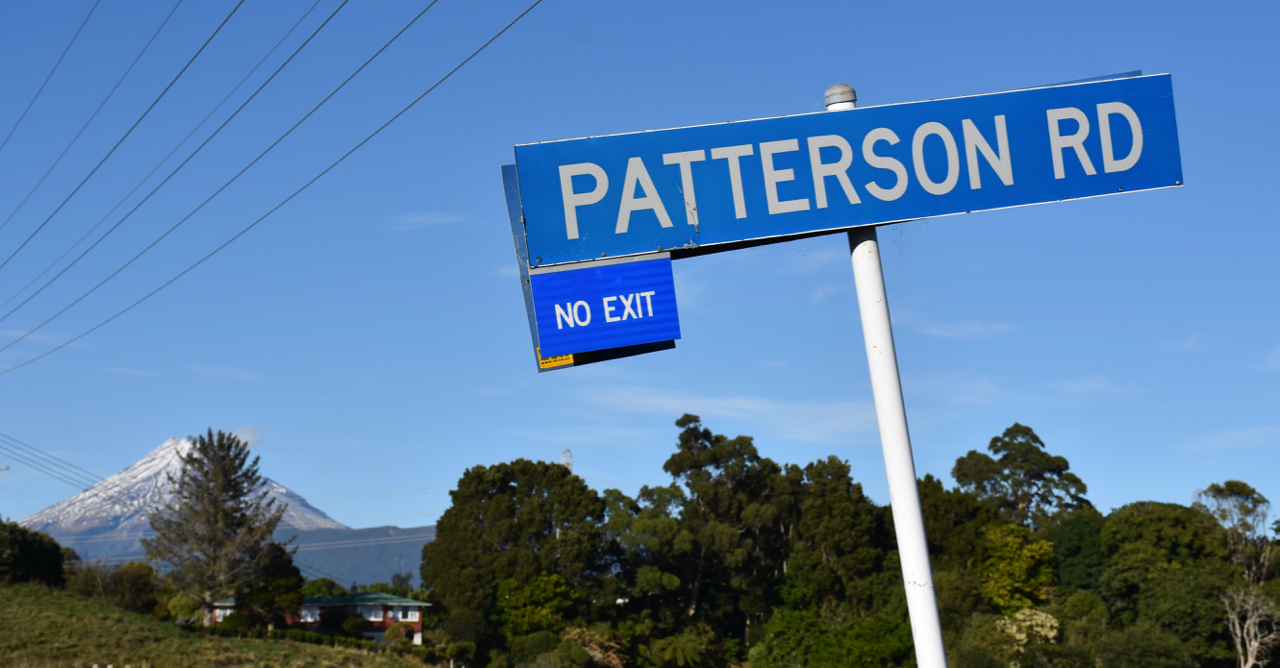
A plaque, erected in 1947, marks the spot where George Patterson was killed on Frankley Rd, near the road that carries his name.
This story was originally published in the Taranaki Daily News.
Please do not reproduce these images without permission from Puke Ariki.
Contact us for more information or you can order images online here.
The information on this website is provided for general research and reference only. While we try to keep content accurate and current, we make no guarantees about its completeness or correctness. It should not be considered a replacement for a LIM or a Property Report. Some content is supplied by third parties. Puke Ariki has not verified this content and users should check its accuracy before relying on it.The inclusion of a building on the website does not imply heritage status. See SCHED1 in the NPDC District Plan for a list of buildings that have rules about what can happen to or around them (administered by NPDC). See the New Zealand Heritage List for a list of buildings that are celebrated for their heritage significance but are not subject to rules (administered by Heritage New Zealand Pouhere Taonga). Should any corrections need to be made to the records or for more information please contact us.


