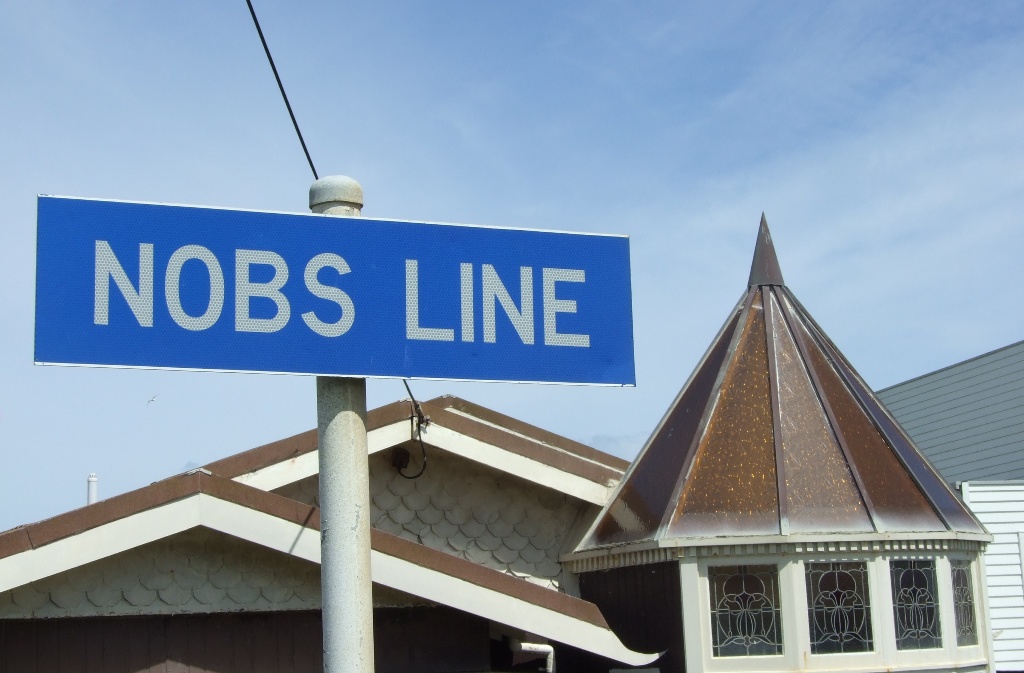
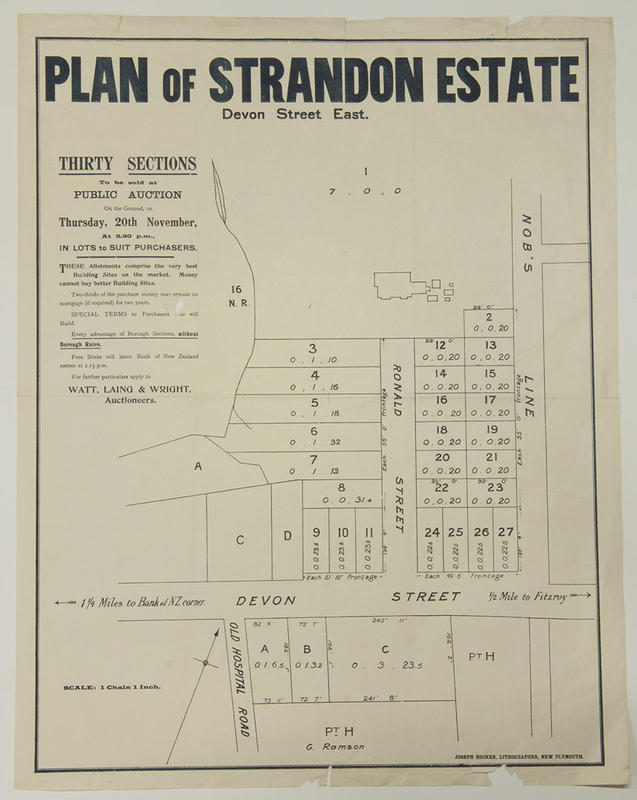
Nobs Line records both an episode in history and an insight into the social structure of early Taranaki and New Zealand.
Between 1843 and 1844, times were tough in New Plymouth and professional people were having difficulty finding work. A number of them took up labouring positions to help the surveyors mark out the boundaries of New Plymouth. Scrub and bush had to be cleared to allow the surveyors line-of-sight to operate their theodolites.
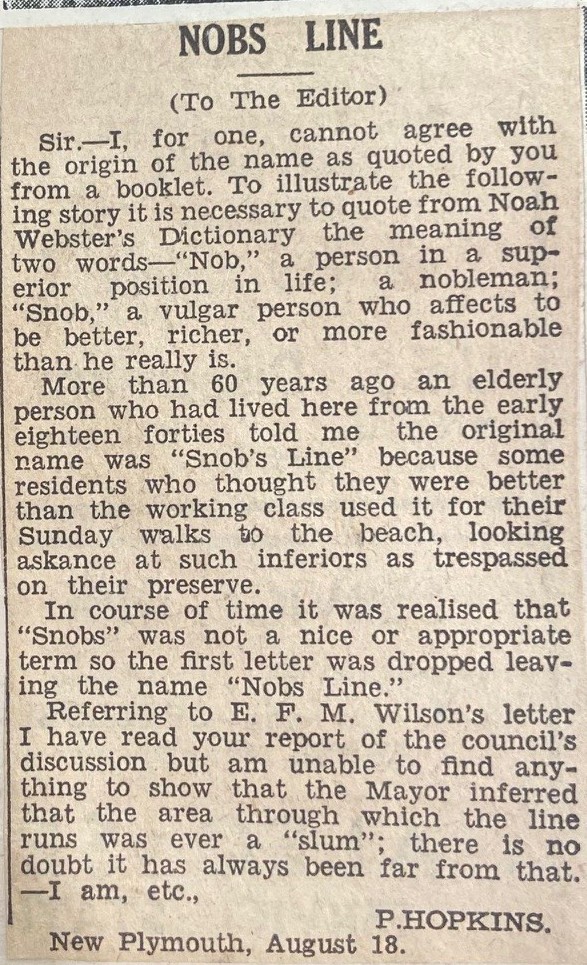
The story goes that the usual labourers were amused when some of these men tried to clear a line through a large rimu using bill-hooks and pocket knives. Their antics earned them the label of "nobs". In England, the nobility were often referred to pejoratively as "the nobs" by the working classes. No doubt this also inferred a lack of practical skills.
So the line that was formed to mark the eastern city boundary became affectionately known as "Nobs Line". Such sarcasm would not have been lost on the local elite though. The English class system still resonated in this new and distant colony.
Consequently the name has had fluctuating popularity and, in 1954, a petition was raised to have a name change. However, the council declined, citing the relevance to local history, and the name remained. Perhaps today, with the value of beach-side properties, we could construe a new meaning for Nobs Line, but that might be difficult in our egalitarian and classless society?
This story was originally published in the Taranaki Daily News.
Related items:
Nobs Line: To The Editor (Taranaki Herald 18 August 1954)
Named In Sarcasm (Taranaki Daily News 19 August 1954)
Please do not reproduce these images without permission from Puke Ariki.
Contact us for more information or you can order images online here.
The information on this website is provided for general research and reference only. While we try to keep content accurate and current, we make no guarantees about its completeness or correctness. It should not be considered a replacement for a LIM or a Property Report. Some content is supplied by third parties. Puke Ariki has not verified this content and users should check its accuracy before relying on it.The inclusion of a building on the website does not imply heritage status. See SCHED1 in the NPDC District Plan for a list of buildings that have rules about what can happen to or around them (administered by NPDC). See the New Zealand Heritage List for a list of buildings that are celebrated for their heritage significance but are not subject to rules (administered by Heritage New Zealand Pouhere Taonga). Should any corrections need to be made to the records or for more information please contact us.