


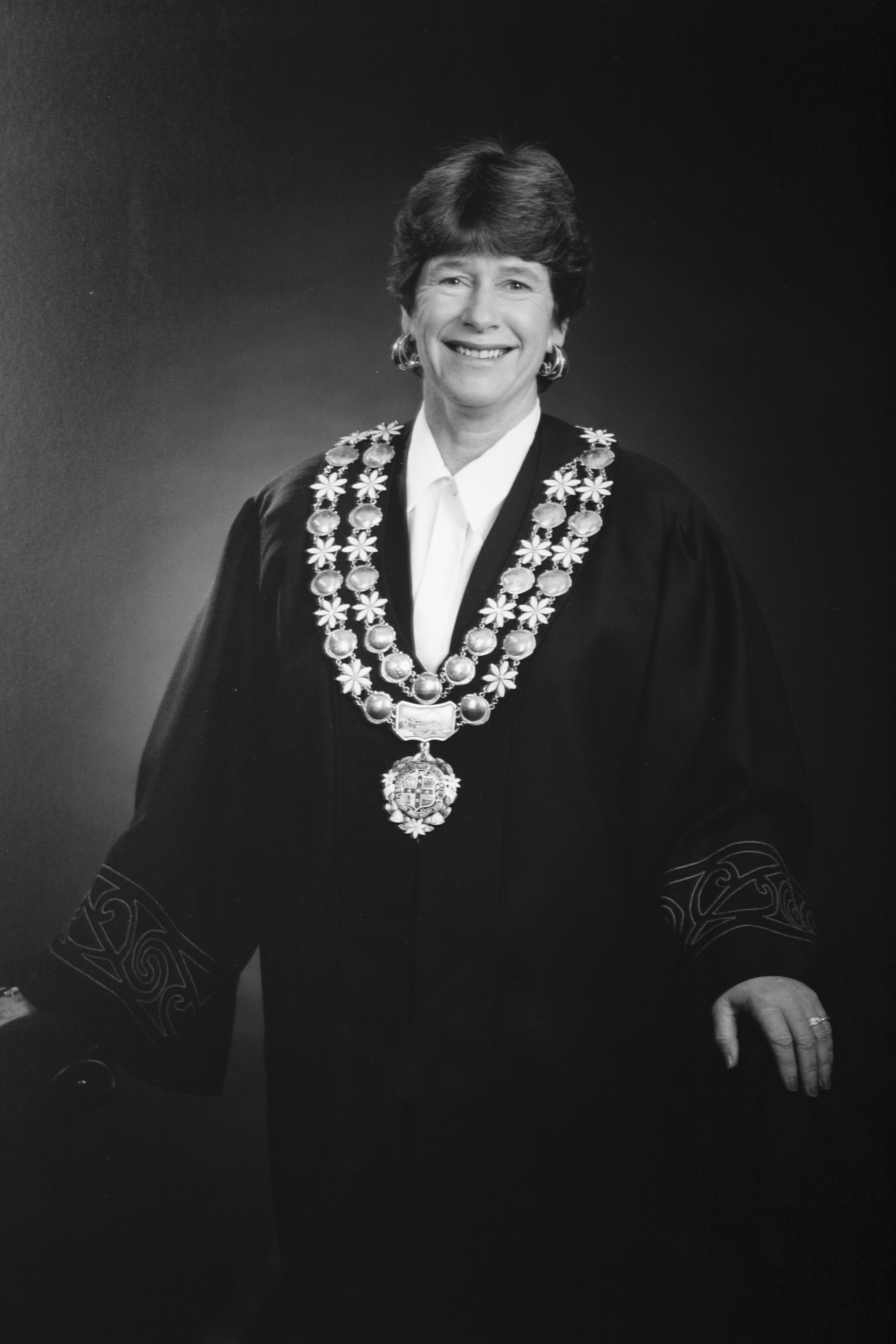
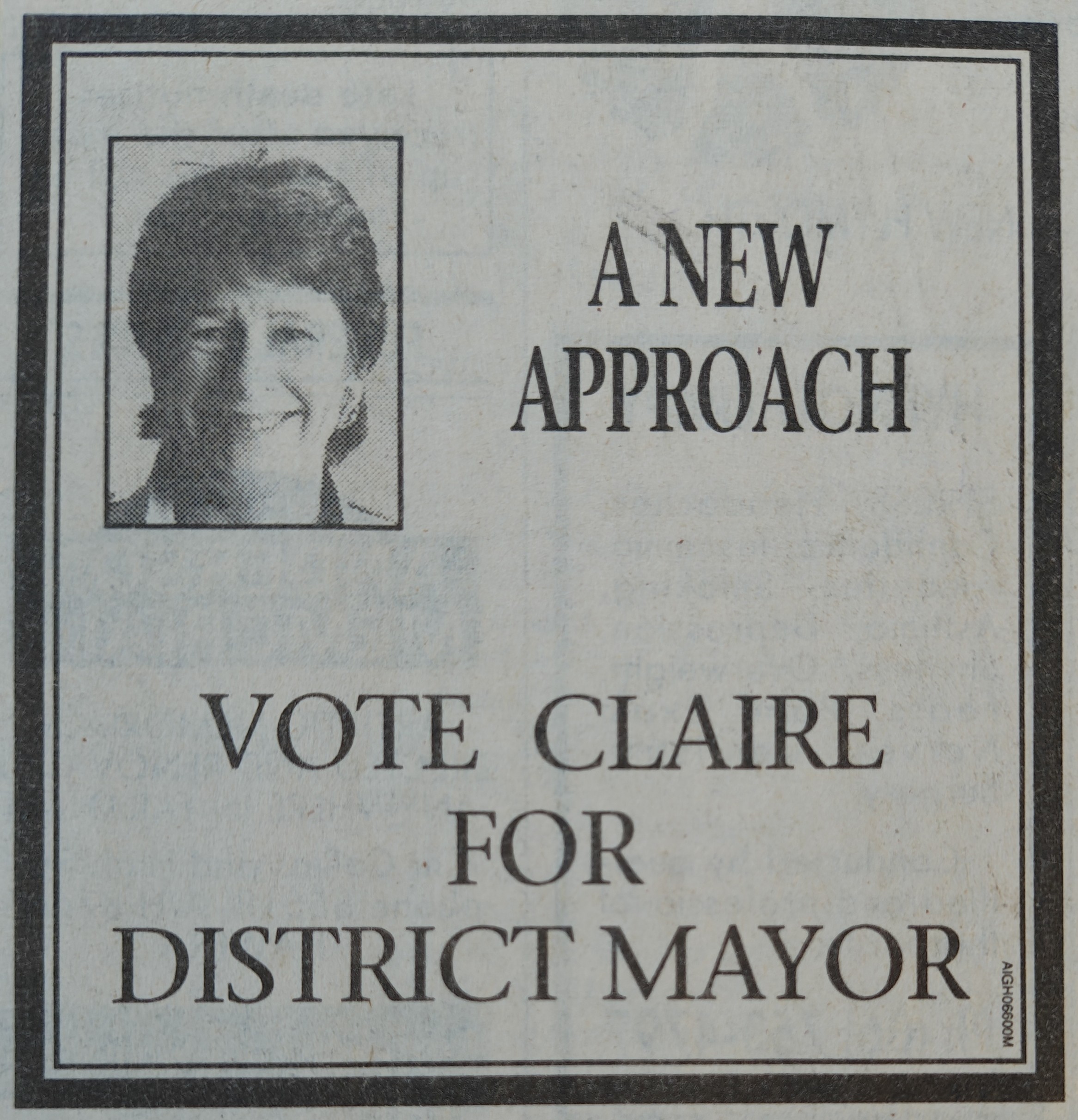
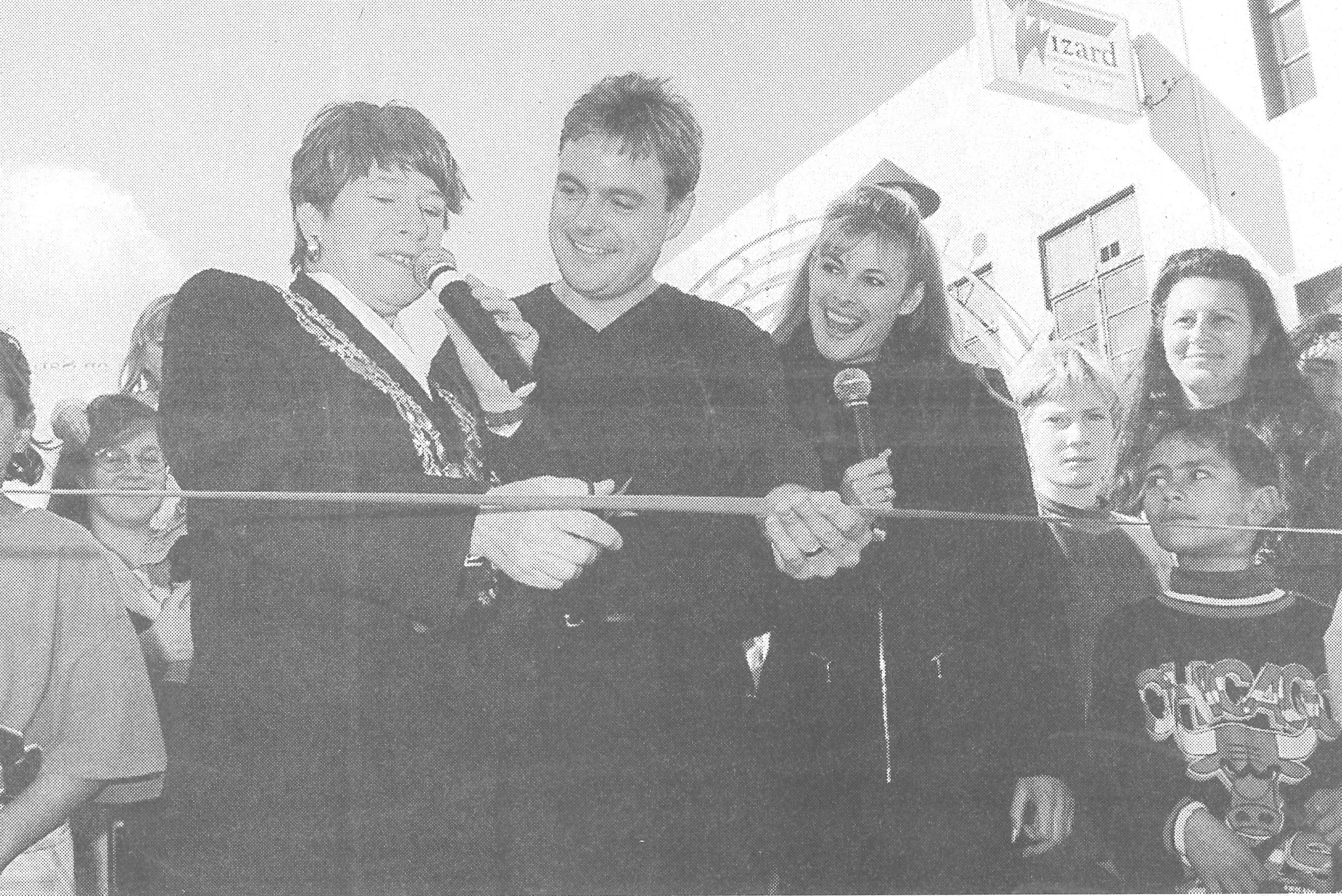
New Plymouth elected it’s first – and so far only – female mayor in 1992.
Claire Lois Stewart was born in Fitzroy on 17 June 1941, the second eldest of four children born to Colin and Joyce Campbell. Educated at Fitzroy Primary School then New Plymouth Girls’ High before attending teachers’ training college in Palmerston North, Claire was sporty as well as smart, playing representative hockey and golf, and involved in swimming, basketball and athletics. She used to joke that by the time she was 35 she “had five children and a golf handicap of four”.
Claire married John Joseph Stewart, known as JJ, in 1961. The couple shared a passion for education and sport – he worked at New Plymouth Boys’ High School for 22 years, coaching Taranaki rugby in the 1960s and the All Blacks in the 1970s.
The Stewarts moved to Flock House farm education centre near Bulls in 1969, where for the next 14 years they taught nearly 1000 young men the basics of farming. They returned to New Plymouth in 1984 and Claire threw herself into community work – she served as chairperson on the board of governors for Girl’s High as well as on the Taranaki Work Trust, TSB Community Trust, Tourism Taranaki, the Taranaki Arts Festival Trust and various other organisations. She was also a Justice of the Peace and helped establish the region’s first Women’s Refuge.
In 1989 Claire decided to stand for the newly amalgamated New Plymouth District Council.
This authority had been formed when New Plymouth City, North Taranaki District, Inglewood District and Clifton County councils were merged on 1 November 1989, with a combined population of nearly 67,000. David Lean had been mayor of New Plymouth City since 1980 and transformed the role from a part-time ceremonial position into a full-time job – he was elected first mayor of the new district and Claire was voted in as a councillor representing the New Plymouth Central ward.
Claire observed what she believed to be a very patriarchal culture in place at the council for three years before deciding to run for the mayoralty herself in 1992. During her campaign she said that she was standing in part to change the “real undervaluing of what women could contribute”.
The local media didn’t exactly help. Newspaper articles took care to stress the fact that Claire had her retired husband’s full support and that her five children, all in their twenties, were independent so wouldn’t be adversely impacted by their mother’s decision to run for office. Her teaching career and community involvement were highlighted as was her membership of St Andrew’s Presbyterian Church and love of dogs.
Claire herself repeatedly used words like co-operation, consultation, listening and accountability, maintaining that the fairer sex thought and behaved differently to men, bringing “a high level of personal skills” to the workplace. Like so many women in the public sphere, she knew she needed to come across as self-assured but not aggressive, nurturing but not weak.
David Lean was only 43 and confident of being elected for a fifth consecutive term. But Claire worked hard, canvassing door to door and delivering leaflets to letter boxes while campaigning on keeping expenditure and rates down. Her efforts paid off and the 51-year-old was elected Mayor on 10 October 1992, beating Lean by 824 votes (13,790 versus 12,966).
Claire was interviewed twice by the museum the following year, first in January 1993, just a few months after her win, and again in April. The female interviewer wondered if she thought being a woman had made a difference to the vote:
I think that was certainly feedback I was getting in canvassing but on the other hand of course the district is conservative in some ways in that it probably meant a good solid support for David also [laughs]. But since being elected I’ve also had a lot of people say “Really good to see a woman there”. People just wanted a change and I think a woman did represent a change in that respect but I couldn’t say what sort of percentage of the vote, that’s really only on feedback I’m getting.
New Plymouth’s recent history of rate rises certainly contributed to Claire’s victory – averaging more than 15% throughout the 1980s and rising at one point to an eye-watering 28%, these paid for urgently needed sewage treatment works, flood protection measures for the CBD, the beginning of an unpopular $21 million reconstruction of council headquarters on Liardet Street, an indoor aquatic centre and a stadium.
The council had also come to be seen as aloof and out of touch, unwilling to communicate with the community that funded its operations. Lean was particularly resented for his so-called "Steinlager Club", a circle of trusted allies including male councillors, officers and local businessmen, who regularly met outside office hours for drinks and to discuss and agree on major issues before they reached committee and council hearings. There was talk of backroom deals and subversion of local democracy:
I’d heard about the Steinlager Club but personally I didn’t actually know who belonged to it or anything. When the press reporter asked me about that I assumed that he meant the former policy committee when I changed the committee structure but I’ve since learned that there was actually another group who used to meet here regularly in the evenings… one or two councillors but in the main it was other interest groups.
Lean and his Steinlager Club were criticised for the council’s ballooning debt ($30 million dollars and rising), for ignoring petitions by residents and even for the amalgamation itself. The papers may have dubbed it Lean’s loss rather than Claire’s win but either way the people of New Plymouth had spoken.
South Taranaki also elected its first female Mayor in 1992, Mary Bourke, and the two women appeared, somewhat dwarfed by their husbands, on the front page of the Taranaki Daily News after the results were announced. Another reassuring reminder that the men in their lives were right behind them.
It was hard to know how to talk about this brave new world. Reporters took great delight in dubbing JJ Stewart the “mayoress” or “mayoral escort” but there were clearly lingering concerns about Claire’s home life:
Your role at home, has that changed a great deal?
Oh, it has – I’m hardly home! Yes, it has in that I’m out of the house up to seven days a week and when I’m very busy in the office and also have meetings in the evening on top of that it means a very long day for me but it also means as far as John’s concerned he often has a meal waiting for me, I don’t go home to a meal if I do have a late day and we have to be very aware of each other’s diaries
So John would be the cook at home?
Well, he’s become really a house husband although he doesn’t call himself that. Yes, he does the cooking and I find that just with two of us in the house, four of the family overseas and one only living locally but flatting, it’s easy enough for me to keep the house in reasonable shape once a fortnight, basically – a really good ‘do’ [clean] once a fortnight.
Once Claire was elected, the national media got involved – much was made in North & South magazine of her “hazel eyes, short-cut tawny hair” and “small, compact, competent figure”. A female mayor may have been novel but residents could relax in a safe, womanly pair of hands.
New Plymouth agreed. Claire was returned to the mayoralty on 14 October 1995 with a massive majority of 7968 votes over challenger Lyn Bublitz and for a third time in 1998, albeit with a reduced majority of 1715 votes (first-time candidate Kevin O'Neill received 9213 votes to Claire’s 10,928 votes while former councillor Harvey Wellington came third with 7515).
She had four different deputy mayors, all men, but New Plymouth District Council did maintain a record number of female councillors on her watch (although this dropped again when a man took back the mayoral chains):
It’s more balanced to have a stronger role of women on council. Women are generally very practical, common-sense people and if you’ve been responsible for budgeting for a family that’s really good background to come here on council and although there’s two or three times the numbers of noughts on the end of the figures it’s still basically the same – if you overspend one week you’ve got to cut back the next. It can be very basic [laughs].
Claire was asked for examples of the kind of sexist behaviour she’d seen from male councillors she worked with, some of whom still thought a woman’s place was in the home. Hearing personal remarks made about female colleagues bothered her, as had an apparent reluctance to actually listen when women spoke:
[I]f you were at a committee meeting, for example, and you made a good suggestion people wouldn’t pick it up but a few minutes later in the debate a man would say it and then it would be accepted. And that still happens – I’m sitting there chairing a meeting as the mayor and I’ll make a suggestion but until the general manager or another male councillor picks it up the whole group won’t actually accept it.
Among the many achievements during Claire’s time in office was the creation of the Coastal Walkway, planning for construction of Puke Ariki, leading a delegation to the Chinese city of Kunming which eventually became a sister city to New Plymouth, and an upgrade of the central business area, involving the removal of Devon Mall and the reopening of Devon Street to traffic in 1997, all of which helped turn Ngāmotu into a more vibrant place.
Rates were reduced, at least for a while, and Claire even approved a 3.3% cut to her own $62,000 salary as well as 5% cuts to the $20,000 salaries of committee chairs and community boards, to prove that the council was committed to a more frugal approach.
She introduced democratic reforms enabling council committees to elect their own chairs, rather than accepting mayoral appointments, which went a long way towards breaking down the cliquey culture she had observed during her first term as a councillor. She also encouraged greater public involvement, especially by Māori, and introduced a code of conduct for councillors, to improve levels of professionalism and limit disrespectful behaviour in the chambers.
In 1992 Taranaki had the third highest unemployment rate in the country at 11%, behind only Gisborne and Northland, but by 2001 it was down to 5.2% and the economy was growing faster than that of the nation as a whole.
Of course there were controversies too.
Completion of the civic centre after ten years of redevelopment work, including construction of a new council chamber for $2.8 million dollars, was seen as an outrageous waste of money by some. There was particular criticism of the decision to spend nearly $20,000 on an extension of Claire’s office that included a private toilet – cue jokes about thrones and chains and council being flush with funds. But, as Claire pointed out, the assumption made when the council building was first designed was that “there would always be a male mayor, who would want to share a facility with a male chief executive” and those days were gone.
Claire surprised everybody when she announced that she would not seek a fourth term as Mayor in 2001. She stepped down to care for her husband JJ, who died of cancer the following year, and was succeeded by her former deputy Peter Tennent.
Claire’s final day in office was 12 October 2001. The Taranaki Daily News reported that “there were no tears” and that Claire remained “philosophical” about the change. She said it had been an honour to serve the citizens who voted for her and that her years as Mayor of New Plymouth had been some of the happiest of her life:
While you have a great deal of responsibility you have challenges that go with it and pressures, but I don’t mind that, I thrive on that, I feel I operate better with pressures and challenges. And then match that with the people contact, the personal contact with the community, trying to do your best, everything to the best of your ability on behalf of the community, well, it’s a wonderful position to be in. And then to have all the back-up resources and information, first-hand information available to you, being at the forefront of very early discussions and projects and things… it’s very exciting.
Claire was made a Companion of the Queen's Service Order in 2001 and later, still only in her sixties, served on the Taranaki Regional Council and District Health Board.
Claire shifted to Australia to be closer to family in 2010 and was interviewed by the Taranaki Daily News before her move, saying that “It was a real honour to serve the citizens who voted me to the position – I just loved it. Local government politics is such a fascinating scene. But… these days family is more important to me. So as much as I love New Plymouth, it's time for me to leave."
Claire Stewart died in Queensland on 29 March 2020 at the age of 78. A memorial service was held in New Plymouth on 17 June 2022, once Covid pandemic precautions had been lifted and her family were finally able to gather. She was survived by her five children and 15 grandchildren.
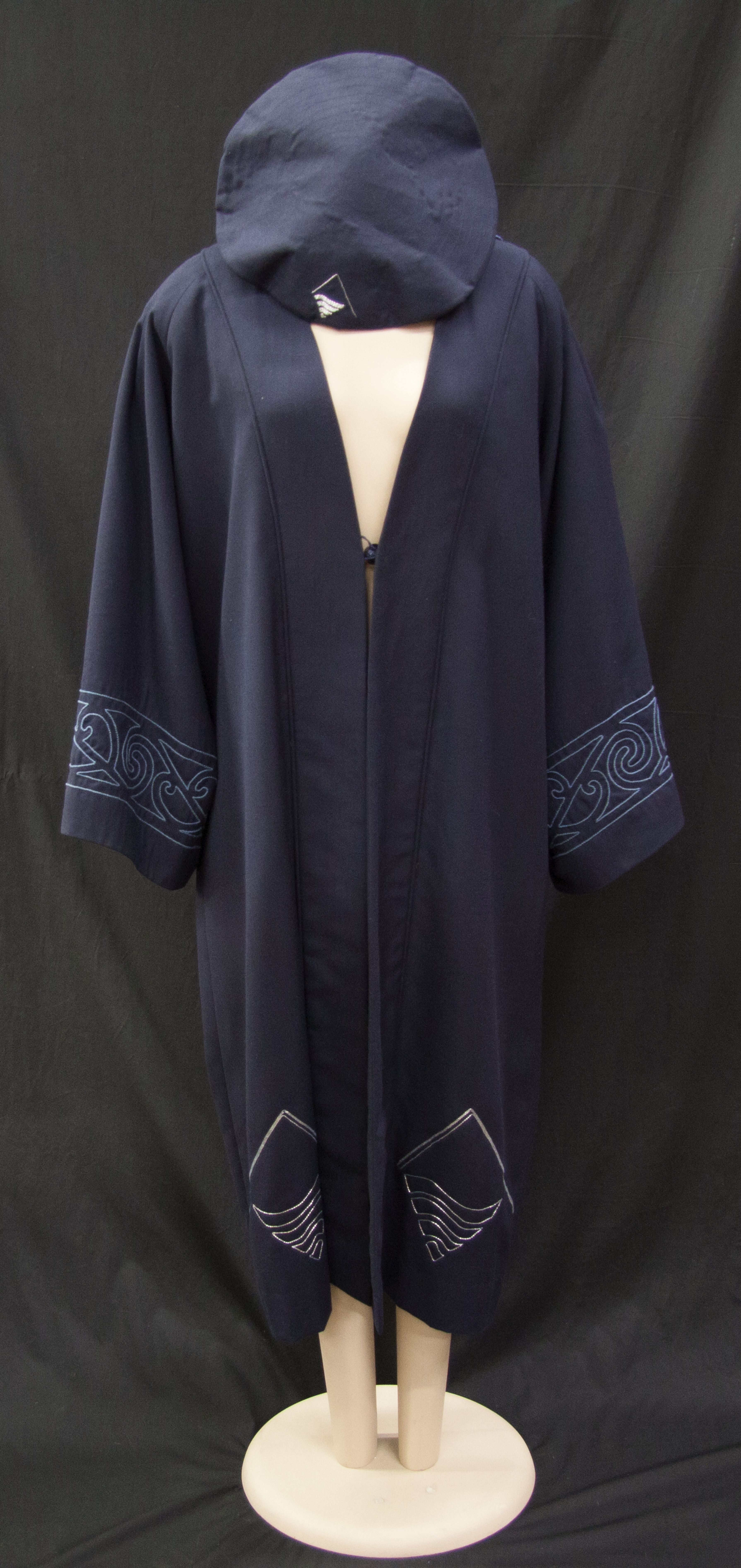
During the first year of her mayoralty, Claire had to wear the heavy, old-fashioned black robes designed for her male predecessors. But in 1993 she had new blue Mayoral robes and a matching hat made. They are currently in storage here at Puke Ariki, perhaps just waiting for our next female mayor to try them on.
.
This story was originally presented as part of the In Her Own Words: More Taranaki Women’s Stories event during Taranaki Heritage Month on 16 October 2026.
Related Documents
Claire Stewart: Facing the Challenge (Ragtime 24 October 1992).
Rookie Who Wouldn't Toe the Line (Taranaki Daily News 10 April 1993)
Claire Stewart Brought a Timely Steadying Hand (Taranaki Daily News 21 August 2001)
Please do not reproduce these images without permission from Puke Ariki.
Contact us for more information or you can order images online here.
The information on this website is provided for general research and reference only. While we try to keep content accurate and current, we make no guarantees about its completeness or correctness. It should not be considered a replacement for a LIM or a Property Report. Some content is supplied by third parties. Puke Ariki has not verified this content and users should check its accuracy before relying on it.The inclusion of a building on the website does not imply heritage status. See SCHED1 in the NPDC District Plan for a list of buildings that have rules about what can happen to or around them (administered by NPDC). See the New Zealand Heritage List for a list of buildings that are celebrated for their heritage significance but are not subject to rules (administered by Heritage New Zealand Pouhere Taonga). Should any corrections need to be made to the records or for more information please contact us.


